
A recently published research paper, authored by the Working Group for Energy Democracy of Tunisia, is on the TUED website and will be the subject of a February 10th TUED Africa Regional Quarterly meeting (RSVP here), details of which can be found at the end of this bulletin.
The paper shows that public solar would be far less expensive than the current approach, which privileges IPPs while imposing excessive costs on the Tunisian people. Under current legislation, private solar PV projects obligate the public power company to buy all the electricity produced at a fixed price according to the proposed capacity. Efforts to reduce energy prices were in vain because the public structure was required to purchase electricity at a higher fixed price (for example, 48 USD/MWh instead of 40 USD/MWh for 10 megawatt projects under the average price of electricity sold to the public structure). In other words the private approach has been burdening public budgets in order to create investor profits that could otherwise have been avoided if the public utility had completed these projects.
The Working Group describes itself as “a praxis-focused space inside the General Federation of Electricity and Gas (FGEG), an affiliate of the UGTT national centre of Tunisia. The working group holds discussions, promotes political education, explores alternatives to the neoliberal energy system, and advances research by and for the working class by linking the trade union struggles with those of communities, social movements, and civil society.”
In late 2025, the government of Tunisia began operating and connecting private photovoltaic plants to the electricity grid. The government claimed that the private plants’ efficiency outperformed public ones. In fact, the pro-private sector energy policies of the government have been a clear failure, barely reaching 200 megawatts of the government’s goal to install 1000 additional megawatts of renewable energies in 2025.
The private photovoltaic plants have not been economically efficient either. As the Working Group explains, the real cost of photovoltaic plants must include the multiple privileges and incentives provided by the government to the private sector. In other words, the private sector under-delivers on its promises while simultaneously pocketing public funds.
Titled "The Real Cost of Electricity Produced From Renewable Energies” the Working Group’s paper compares the different types of private electricity production and explores the impact of the new energy legislation on the real cost of electricity produced from renewable energies. The paper looks specifically at the adoption of a fixed tariff regime bypassing a request for proposals that might create space for small plants.
Private sector lobbyists and the government use cherry-picked and misleading numbers to justify the privatization of renewable energies but, as the paper argues, it is illegitimate to compare the full cost of producing electricity through the public utility with the selling price of electricity generated by subsidized private solar PV producers.
Drawing on official figures and legislative analysis, the paper’s findings support trade union arguments for public electricity– not as a matter of ideological conviction but rather of data-based, logical cost-analysis. The paper’s findings reflect favourably on the efficiency of public electricity production as well as the advantages of implementing renewable energy projects through a public company. As the Tunisian trade union movement has long argued, the obligation of public companies is to provide the people of Tunisia with affordable electricity – not to produce profits for private pockets at the public’s expense.
Although the report is data-driven, it also identifies that a battle of ideologies and narratives is taking place. The report aims to counter neoliberal energy approaches by fact-checking and debunking their arguments while also favoring public approaches and arming unions with the necessary support for their point of view.
“The ideological-cultural battle, unlike the military battle, must focus on the strengths of the enemy and therefore must mobilize the most important tools at our disposal.” - Antonio Gramsci
For further background, see TUED Bulletin 163,Threatening to Strike, Energy Unions in Tunisia Win a Victory for Public Energy and Worker Rights.
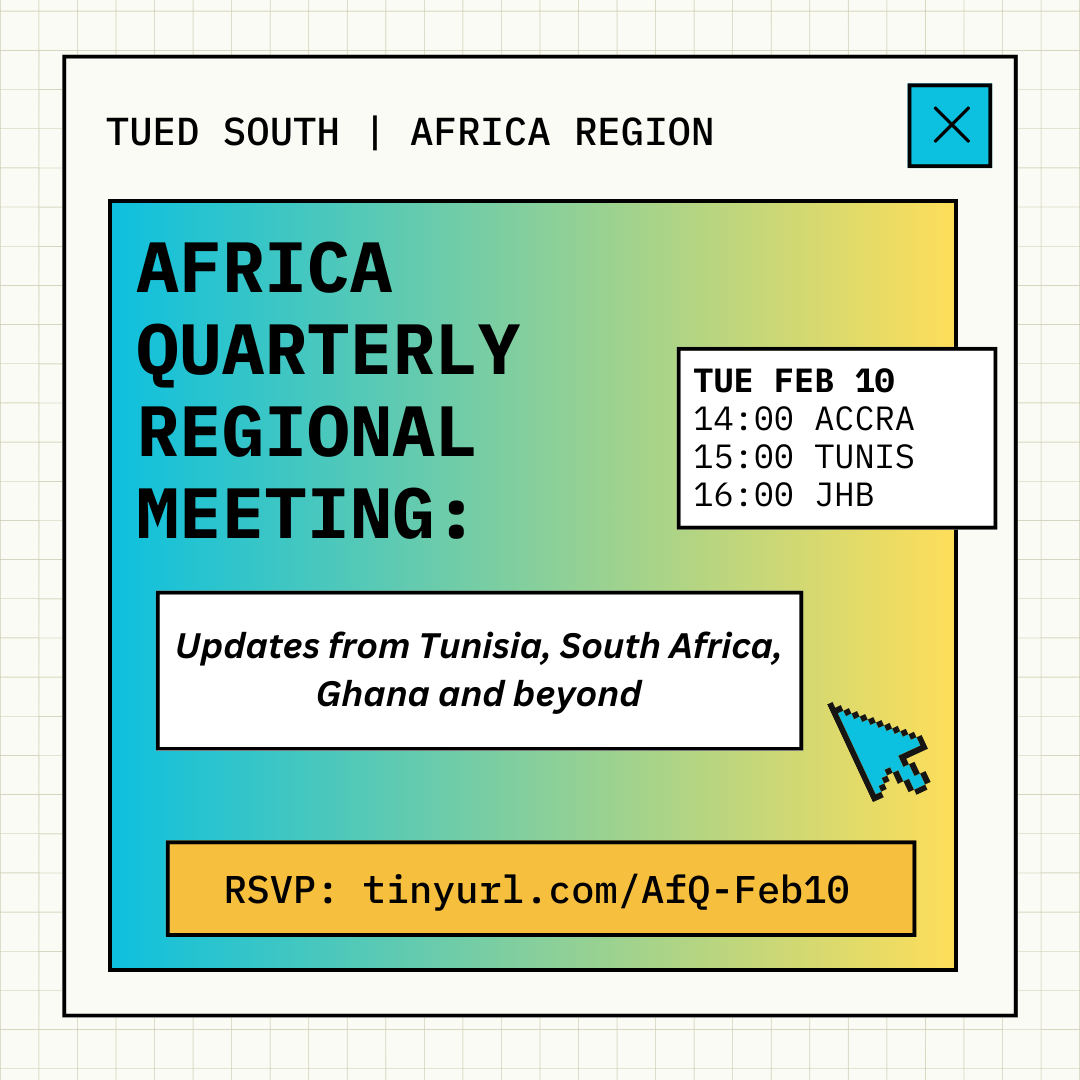
Join us on Tuesday, February 10th for the first Africa Regional Quarterly Meeting of the year. More than 80 trade union members and allies have already registered from at least a dozen African countries.
Date: February 10th, 2026
Time: 15:00 Tunisia // 16:00 South Africa
Find your local time here
Simultaneous interpretation will be provided in Arabic, French and English, with the possibility of additional languages, according to registrants’ needs and available resources.
Tunisian comrade Elyes Benammar of the General Federation of Electricity and Gas (FGEG), and member of the Working Group for Energy Democracy, will present on the significance of the research paper, The Real Cost of Electricity Produced From Renewable Energies. The meeting will also include brief interventions from comrades in Ghana and South Africa on similar case studies. All comrades are welcome. We hope to see you next Tuesday!
.png)


