
Belem, Brazil – Representing tens of millions of workers in the Global South, more than 100 unions and union-based allies have called for decision makers at COP30 in Belem, Brazil, to acknowledge the need for a radical policy shift away from the investor-focused for-profit framework towards a public pathway approach.
Signed by numerous national trade unions centres, as well as the Africa Region of the International Trade Union Confederation (ITUC-Africa), the Trade Union Confederation of the Americas (TUCA-CSA), and Public Services International (PSI), the Global South unions’ statement reinforces the International Trade Union Confederation’s (ITUC) World Congress commitment to fight for reclaiming energy to public ownership and control.
“Reclaiming energy is essential to a just transition, because the North is still pushing a privatisation agenda across the Global South. This is not only socially regressive, it’s been shown to be ineffective as a climate policy,” said TUED’s Latin America coordinator, Lala Peñaranda, who announced the 100-union statement at a meeting on November 19th in the COP30’s Blue Zone in Belem.
“The primary reason why emissions targets and climate finance goals are not being met is because neoliberal policies put unjustified hope in private capital, when what’s needed is a global public goods model anchored in a program to reclaim and restore public utilities and services,” said Peñaranda.
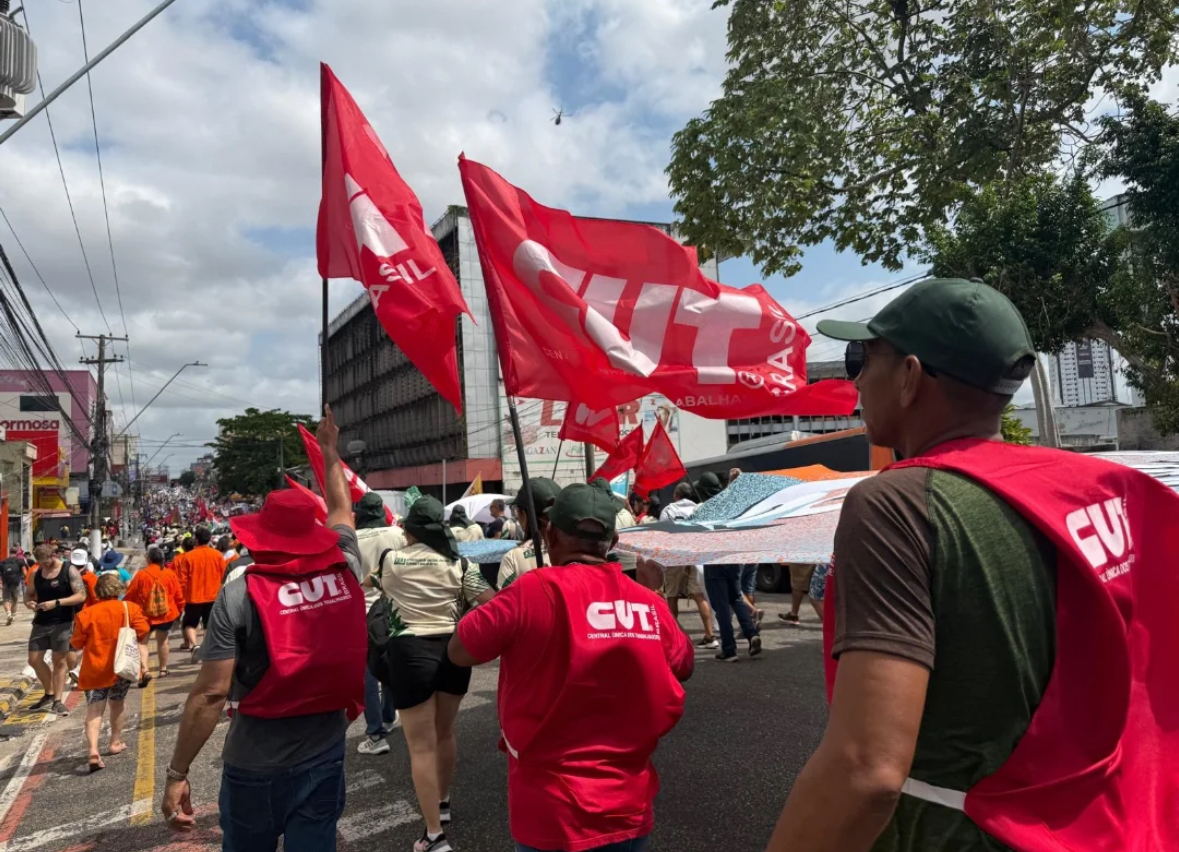
Unions and their allies have worked hard at COP30 to get the most out of the negotiations. They have been laser-focused on pushing for solid commitments around the Belém Action Mechanism (BAM) for a Just Transition. The G77 + China, the African Union, the Least Developed Countries (LDCs), and the Alliance of Small Island States (AOSIS) were among those supporting a robust BAM, although a number of rich countries (among them the EU, the UK and Australia) argued against a new mechanism.
“Alongside the emphasis on the need to recognise basic worker rights and climate justice, the BAM discussions provided an opportunity for us to insist on a shift away from investor-focused approaches that are clearly not producing a transition, just or otherwise, ” said Peñaranda. “Many unions, especially those in the South, believe that a ‘public pathway’ approach has the potential to deliver a truly just transition, whereas the current policy framework can not.” This perspective, she said, must feature more prominently in trade union demands at future COPs and in other multilateral spaces.
As COP 30 draws to a close, Global South unions will continue to resist the “privatise to decarbonise” agenda of the rich countries, a policy that produced several Just Energy Transition Partnerships (JETPs), each of which focus on expanding the role of private sector while undermining public ownership and control.
At a “Unions Live from COP 30” TUED global forum on Monday, November 17th, union representatives in Belem made reference to the vibrancy of the social movements both at the COP and the People’s Summit. Presenting on the crisis of neoliberal climate policy, TUED’s Sean Sweeney urged unions to be alert to efforts from Bill Gates, Jeffrey Sachs, Tony Blair and other members of the global elite who are calling for a ‘climate reset.’
“This amounts to an admission that the neoliberal climate policy framework has failed. But instead of acknowledging the failure, they want to effectively abandon the commitments made under the Paris Agreement,” said Sweeney. “This is unacceptable and must be resisted by unions and their allies. But the best way to resist is for unions and social movements to propose a new policy architecture based on global public goods, progressive internationalism, and non-commercial cooperation.”
For more on the current crisis of neoliberal policy and the need for a South-led pro-public alternative, see TUED’s latest working paper Towards a New International Energy Order.

.png)


