
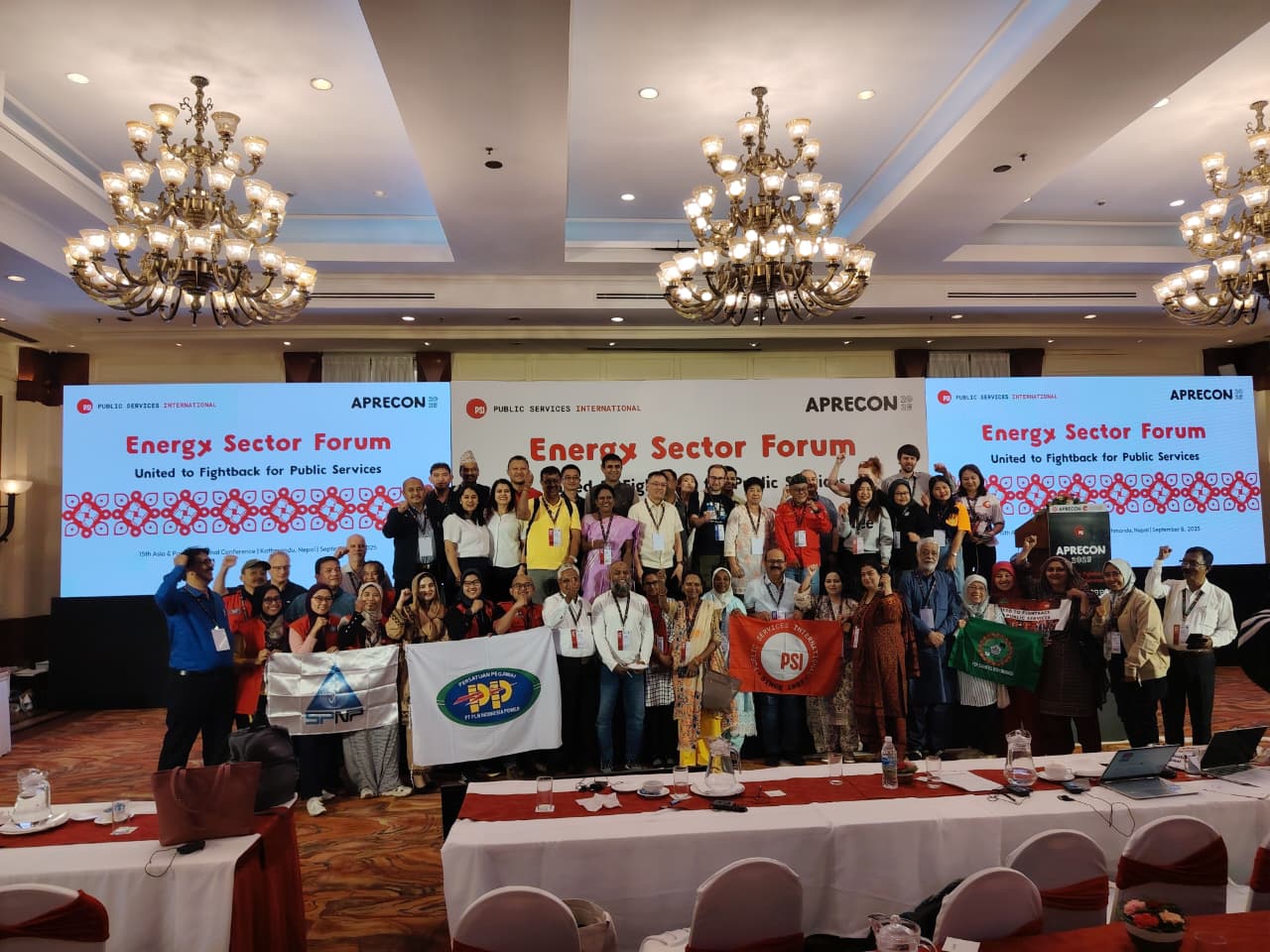
Ninety-two public sector unions from 23 Asia-Pacific countries have unanimously endorsed public pathway approaches to energy transition. Representing 1.1 million unions affiliated to Public Service International (PSI) the 300-person delegation met in Kathmandu, Nepal, during September 9th-12th for PSI’s 15th regional conference (APRECON 2025).
The conference opened under curfew conditions following an uprising of Nepalese youth that claimed the lives of more than 20 protestors that were shot by police. See: APRECON Video Message offering condolences to the victims.
The rallying cry for the conference–United to Fightback for Public Services–resonated loudly in several discussions on energy transition and climate change, where affiliates spoke to growing climate instability, rising prices for electricity, and the need oppose the neoliberal agenda and organise around a clear public pathway alternative.
APRECON 2025 unanimously adopted two resolutions on energy transition, both of which endorsed the public pathway approach as proposed by the TUED network.
Moving Resolution 3, the Korean Public Service and Transport Workers’ Union (KPTU) called on the Korean Government and the National Assembly to immediately pass the union-supported Public Renewables Act to expedite the country’s energy transition and thus recognise the need for a “public pathway approach and remunicipalisation of energy are irreversible global trends.” (The struggle for public renewable energy in Korea will be discussed in a future TUED bulletin.)
APRECON 2025, DRAFT RESOLUTIONS SUBMITTED BY THE AFFILIATES
RESOLUTION #3: THE KOREAN GOVERNMENT AND NATIONAL ASSEMBLY MUST PASS THE PUBLIC RENEWABLES ACT IMMEDIATELY!
The 15th Asia Pacific Regional Conference (APRECON) Meeting in Kathmandu, Nepal, 8 - 11 September 2025
NOTES the situation in Korea, where the government's policy to close 40 out of 58 coal-fired power stations by 2038 is expected to result in 16,000 job losses, including 2,000 irregular workers, as well as an economic loss of around 5.5 trillion won in regions with a high concentration of coal-fired power stations,
CONDEMNS the Korean government for failing to propose any measures and for seizing upon the energy transition as an opportunity for privatisation at this critical moment, when measures to secure workers' employment and ensure the sustainability of local communities are urgently needed,
particularly CONCERNS that the government is allowing private renewable energy to fill the gap left by the closure of predominantly publicly owned coal-fired power stations, given that over 90 per cent of Korea's renewable energy facilities, as well as 92.8 per cent of approved offshore wind power capacity, are already privately owned,
SUPPORTS the KPTU's campaign for the Framework Act on Expansion of Public Renewable Energy (Public Renewable Energy Act), carried out in collaboration with climate justice groups, to ensure the right to energy, support workers and local communities most affected by the closure of coal- fired power stations, and promote the public pathway approach,
URGES the Korean government to recognise that the public pathway approach and remunicipalisation of energy are irreversible global trends and calls on the government to join this global trend by passing the Public Renewable Energy Act.
Submitted by Korean Public Service and Transport Workers' Union (KPTU)
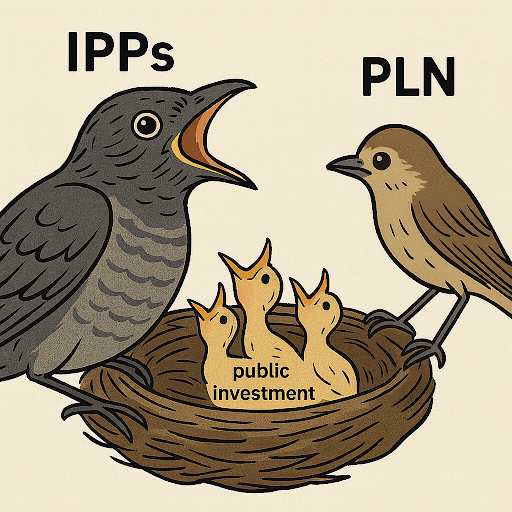
Submitted by power sector unions in Indonesia, Resolution 9 (see below) called on the government of Indonesia to pursue an energy transition consistent with Article 33 of the country’s 1945 constitution which protects state control of the country’s vital resources. It called for the government to put a stop to the predatory practices of for-profit independent power producers (IPPs).
Encouraged by the legal victory in late 2024 that saw the country’s Constitutional Court declare government efforts to privatise the country’s power sector by increasing the presence of for-profit independent power producers (IPPs) to be in violation of Article 33, the PLN unions have worked alongside TUED and PSI to develop the “Article 33 Scenario” alternative to the government’s plans.
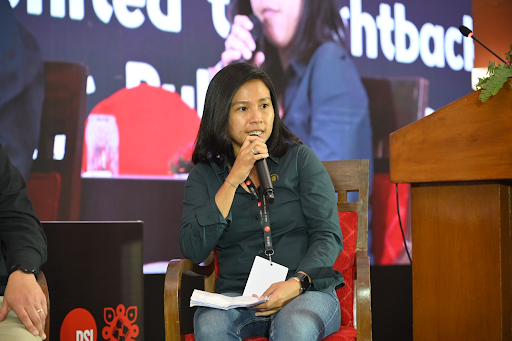
Moving Resolution 9 on behalf of the unions at the national utility PLN, Efrida Gusti Handayani (representing the energy union PPIP) urged delegates to support their fight for a public pathway approach to energy transition both in Indonesia and across the region.
[See comrade Efrida Gusti’s full 5-minute intervention on Resolution 8]

However, she warned that the government of Indonesia had not yet complied with the Court’s decision, and was pushing for more IPP involvement in the coming decade. “Labor unions do not oppose the energy transition but the transition must be done in the best public interest with state ownership, safe for the environment and for everyone,” she said. Handayani added, “This is why we made this resolution: [it is] a call for a Public Pathway approach, not just for Indonesia, but for all countries across Asia-Pacific.”
The resolution was adopted in a unanimous vote.
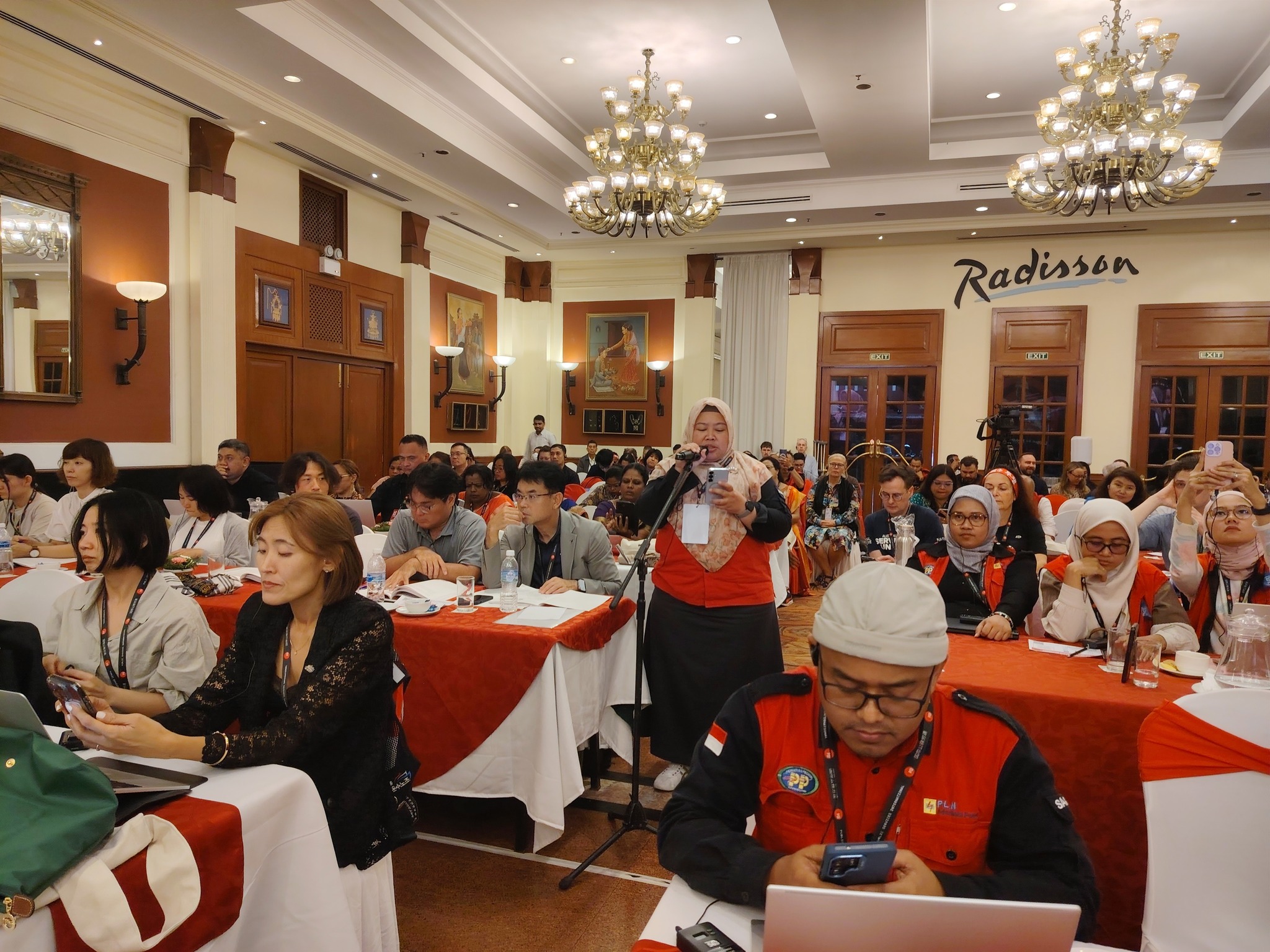
In an APRECON 2025 plenary session, Irma Rahmawati—representing the power sector union SP PLN—similarly referred to the Article 33 Scenario, as did SP-PLN General Secretary Budi Setianto who remarked that the trade union response to the threat of privatisation had initially been sporadic, but the PLN unions now had a stronger position and were well placed to actively campaign around the Article 33 Scenario alternative
During a half-day energy forum, TUED’s Sean Sweeney suggested that governments can give private investors and IPPs the red carpet treatment by way of de-risking their projects, but there were clear signs that IPPs in the renewables sector were engaging in what he termed an “investment strike” in Indonesia, and were applying political pressure to secure lucrative returns under legally binding power purchase agreements (PPAs).
PSI’s Regional Secretary Kate Lappin encouraged affiliates to consider the Article 33 Scenario when assessing how best to resist the push to privatise electricity.
APRECON 2025, DRAFT RESOLUTIONS SUBMITTED BY THE AFFILIATES
RESOLUTION #9: ENERGY TRANSITION IN INDONESIA AND THE NEED FOR A PUBLIC PATHWAY APPROACH
The 15th Asia Pacific Regional Conference (APRECON) Meeting in Kathmandu, Nepal, 8-11 September 2025
WELCOMES the December 2024 decision by the Constitutional Court of Indonesia reaffirming the legal validity of state control of the country's electricity sector as stipulated in Article 33 of the 1945 Constitution article (2) and (3).
APPLAUDS the work of the Gerakan Kesejahteraan Nasional (GEKANAS) coalition, including PSI affiliates, in petitioning the Court and securing this significant victory for progressive forces in their struggle to fight privatisation and liberation of electricity.
CONSIDERS the government's recent proposals to expand the role of Independent Power Producers (IPPs) against the Court's December 2024 decision. If realised, this expansion will compromise the Indonesian state-owned electric utility company's (PT PLN Persero) finances which leads to an increase in the state's financial burden, making electricity prices unaffordable for the public, weaken the utility's capacity to drive the energy transition, and leave final investment decisions in the hands of foreign multinationals.
NOTES the current investment strike by IPPs and private capital; the country faces an investment shortage in geothermal, hydroelectric and solar power, technologies that are crucial to both the country's energy transition and for a planned reduction in coal dependency
IS ALARMED by the neoliberal conditionalities that accompany the proposed Just Energy Transition Partnership (JETP) with Indonesia, including the removal of price controls and the extension of ownership rights to private interests. These proposals amount to "green structural adjustment" and will compromise the country's energy sovereignty, policy independence, and likely increase electricity prices for the working class and small businesses.
CALLS UPON the government of Indonesia to reassess its energy transition policy framework in the light of the decision of the Constitutional Court and to adopt policies that are consistent with Article 33 and a "public pathway" approach
FURTHER CALLS UPON the government of Indonesia to reinstate PT PLN Persero as a vertically integrated public utility, thus emulating Mexico's decision to limit the presence of IPPs and to pursue a policy anchored in public ownership and prudent energy planning.
URGES the Government of Indonesia, in the spirit of the Bandung conference of 1955 and in the light of the rich countries' failure to meet their climate obligations, convene a process that is dedicated to building South-South cooperation to address the threat of climate change. And urges the Government of Indonesia to fully implement all Decisions of the Constitutional Court of the Republic of Indonesia related to the Judicial Review of the Electricity Law, in the spirit of Indonesian nationalism and patriotism, by enacting legislation that genuinely upholds the mandate of the Constitution.
FURTHER URGES the Government of Indonesia to realign the management of electricity as a strategic national asset by prioritizing the interests of the Indonesian people - particularly in relation to private land ownership, customary (ulayat) rights, and collective access to natural resources under state governance - in order to realize the nation's vision of energy sovereignty, and urges the government of Indonesia to use its influence in multilateral spaces to champion a global public goods approach to energy transition and climate protection, where the costs of transition are shared by all, within the framework of common but differentiated responsibilities under the United Nations Framework Convention on Climate Change (UNFCCC).
RESOLVES to continue the campaign for a Public Pathway to secure a just and equitable energy transition in Indonesia. Further resolves to share experiences of the fight for public pathways across the region to secure public energy and decent work for all.
Submitted by:
Federasi Serikat Pekerja Farmasi dan Kesehatan Reformasi (FSP FARKES R)
Serikat Pekerja PT PLN Persero (SP PLN)
Serikat Pekerja PT PLN Nusantara Power (SPNP)
Persatuan Pegawai PT PLN Indonesia Power (PP-IP)
Serikat Pekerja Angkasa Pura Indonesia (SP API)
Serikat Pekerja Perusahaan Air Minum Jakarta (SP PDAM Jakarta)
Serikat Pekerja Badan Penyelenggara Jaminan Sosial Ketenagakerjaan (SP BPJS TK)

The Argentine government announced that it will sell 44% of the shares in Nucleoeléctrica Argentina, the state-owned company that controls the nuclear power plants.
"It is a loss of energy sovereignty," says TUED member Rodolfo Kempf [pictured], physicist at the National Atomic Energy Commission (CNEA) and coordinator of the National Coordination of Workers in Industry (CNTI) of the Autonomous CTA (CTA-A).
"The government is trying to push through privatisation that favours concentrated, monopolistic capital,’ warns Kempf, who also points to the dire situation of workers in the area and the "attempt to form, together with US capital, a company called Meitner Energy (...) with which they are taking key personnel, sectors and knowledge from the nuclear sector and transferring them to a private company, thereby losing sovereignty and technological and industrial capabilities in Argentina." Read the full Canal Abierto article here.

UNTyPP expresses its full support and solidarity with our colleague Iván Alfonso de la Torre Vega, Secretary of Organisation, Minutes and Agreements of Section 10 of the Independencia Petrochemical Complex, who is a victim of harassment, persecution and workplace violence within his workplace [in Petróleos Mexicanos (PEMEX)].
WE DECLARE the case of Iván de la Torre is a clear example of repression and abuse of power, based on administrative investigations that violate due process and undermine the dignity and stability of workers.
Read the full statement in Spanish and English. Stand in solidarity by helping spread the word on Twitter here.
.png)


